Last checked 2 November 2026
The four conditions in section 16(2)
- You hold a tax invoice, debit note or other valid document from the supplier.
- The invoice details have been furnished by the supplier and appear in your GSTR-2B (section 16(2)(aa)).
- You have received the goods or services. Goods delivered to a third party on your direction count as received.
- The supplier has actually paid the tax, and you have filed your GSTR-3B.
For goods received in lots against one invoice, credit is taken when the last lot arrives.
A worked example
A hardware dealer in Indore has these figures for October:
| Amount | |
|---|---|
| GST on sales (output tax) | ₹54,000 |
| GST on purchases in GSTR-2B, all conditions met | ₹41,000 |
| GST on a new car for the owner (blocked) | ₹1,20,000 (not claimable) |
| Tax payable in cash | ₹54,000 − ₹41,000 = ₹13,000 |
The car credit is blocked under section 17(5), so it adds nothing. Credit unused in a month carries forward in the electronic credit ledger.
GSTR-2B and the Invoice Management System
GSTR-2B is a monthly statement of the credit available to you, built from what your suppliers report in their GSTR-1 or IFF. Since October 2024 the Invoice Management System (IMS) on the GST portal lets you accept, reject or keep pending each supplier invoice before GSTR-2B is finalised. Rejecting an invoice you never received keeps wrong credit out of your return. Reconcile your purchase register with GSTR-2B every month before filing GSTR-3B: credit the supplier has not reported cannot be claimed yet.
Pay suppliers within 180 days
If you do not pay the supplier the value plus tax within 180 days of the invoice date, the credit taken on it must be added back to your output tax, with interest (second proviso to section 16(2) and Rule 37). When you pay later, you can claim the credit again. This does not apply to reverse charge purchases.
Blocked credits (section 17(5))
Credit is not allowed on, among others:
- Motor vehicles for carrying up to 13 people (including the driver), with exceptions for dealers, taxi and transport businesses and driving schools; their repair and insurance follow the same rule.
- Food and beverages, outdoor catering, beauty treatment, health services, cosmetic surgery, club and gym memberships, unless used to make the same kind of taxable supply or required by law for employees.
- Travel benefits for employees on vacation, like leave travel.
- Works contract and goods or services used to construct immovable property (other than plant and machinery) on your own account.
- Tax paid under the composition scheme.
- Goods lost, stolen, destroyed, written off, or given away as gifts or free samples.
- Goods or services for personal use.
Where something is used partly for business and partly for exempt or personal use, credit is split under Rules 42 and 43.
Time limit and order of use
Time limit: credit for a financial year must be claimed by 30 November of the next year, or the date you file the annual return, whichever is earlier (section 16(4)). Credit on a 2025-26 invoice missed in that window is lost.
Order of use: IGST credit is used first, against IGST and then CGST and SGST in any proportion. CGST credit cannot pay SGST and vice versa (section 49 and Rule 88A). Businesses with taxable sales above ₹50 lakh a month must, with some exceptions, pay at least 1% of output tax in cash (Rule 86B).
A monthly ITC routine
- Record every purchase bill with the supplier’s GSTIN, number and date as soon as it arrives.
- Around the 14th, compare your purchase register with GSTR-2B and act on the Invoice Management System.
- Follow up with suppliers whose invoices are missing.
- Mark blocked and personal items as ineligible.
- Reverse credit on bills unpaid for 180 days, and reclaim it when paid.
Common mistakes
- Claiming credit from the purchase register instead of GSTR-2B.
- Forgetting to reverse credit on invoices unpaid after 180 days.
- Claiming credit on staff lunches, the owner’s car or gifts.
- Missing the 30 November deadline for the previous year’s invoices.
- Interest: wrongly availed credit that is used attracts interest at 18% a year (section 50(3), as amended from 1 July 2017).
How billinginfo helps
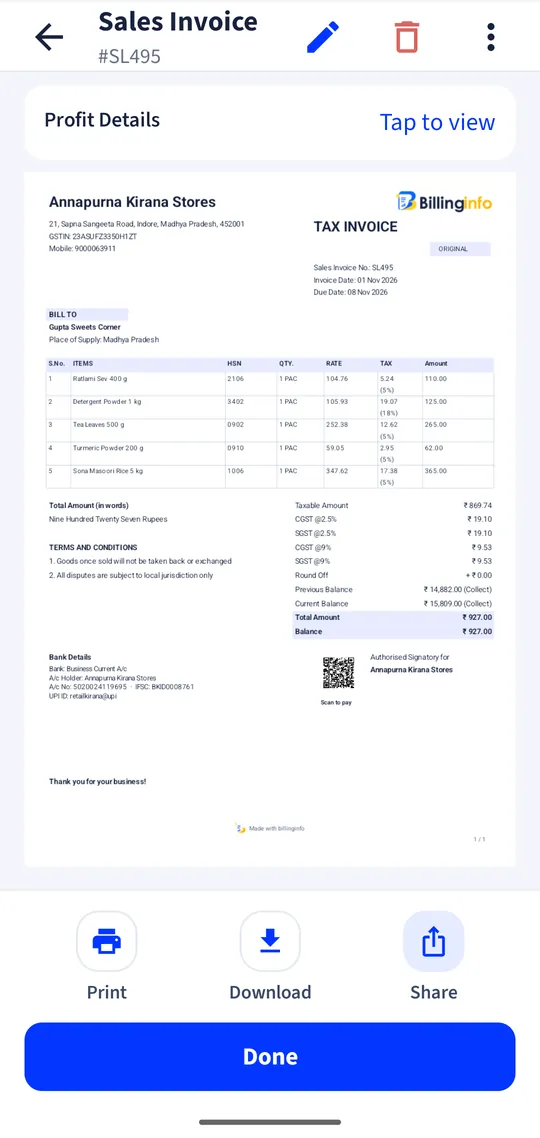
Every purchase and expense in billinginfo records the supplier’s GSTIN and tax, with an input tax credit type on expenses (eligible, ineligible, capital goods and so on). The GSTR-2 report lists your purchases for matching with GSTR-2B, and the GSTR-3B report puts eligible credit in the right table. Supplier dues show which bills are near the 180-day mark.