Last checked 2 November 2026
Due dates
| You file | Due date |
|---|---|
| Monthly | 20th of the next month |
| Quarterly (QRMP), businesses in Chhattisgarh, Madhya Pradesh, Gujarat, Maharashtra, Karnataka, Goa, Kerala, Tamil Nadu, Telangana, Andhra Pradesh and the Union Territories of Dadra and Nagar Haveli and Daman and Diu, Puducherry, Andaman and Nicobar Islands, Lakshadweep | 22nd of the month after the quarter |
| Quarterly (QRMP), all other States and UTs | 24th of the month after the quarter |
Under QRMP you pay tax for the first two months of the quarter by the 25th of the next month with Form PMT-06, either a fixed sum worked out by the portal or the actual tax due.
The tables that matter
| Table | What you declare |
|---|---|
| 3.1 | Outward supplies and tax: taxable, zero-rated, nil and exempt, non-GST; and inward supplies under reverse charge |
| 3.2 | Inter-State supplies to unregistered persons, composition taxpayers and UIN holders, by State |
| 4 | Input tax credit: (A) available, (B) reversed, (C) net, (D) ineligible |
| 5 | Exempt, nil and non-GST purchases |
| 5.1 | Interest and late fee |
| 6 | Payment: tax set off from the credit ledger and the rest in cash |
Tables 3.1 and 3.2 are filled in from your GSTR-1 (or IFF and GSTR-1A); Table 4 from your GSTR-2B. Check both before filing.
A worked example
A Pune trader for October:
| IGST | CGST | SGST | |
|---|---|---|---|
| Output tax (Table 3.1) | ₹7,000 | ₹22,500 | ₹22,500 |
| Input tax credit (Table 4) | ₹12,000 | ₹15,000 | ₹15,000 |
| IGST credit used for IGST | −₹7,000 | ||
| Remaining IGST credit ₹5,000 used for CGST/SGST | −₹2,500 | −₹2,500 | |
| Own CGST/SGST credit used | −₹15,000 | −₹15,000 | |
| Cash payable | ₹0 | ₹5,000 | ₹5,000 |
IGST credit is always used first. CGST credit cannot pay SGST, and the other way round. The portal does this set-off when you click “Make payment”.
Auto-filled values and the July 2025 lock
From the July 2025 tax period, the outward tax liability that GSTR-3B fills in from GSTR-1, IFF and GSTR-1A cannot be edited in GSTR-3B. If the figure is wrong, correct the sales data through GSTR-1A (before filing GSTR-3B) or in the next GSTR-1. Credit figures from GSTR-2B can still be changed, but the portal warns you when the change is large. In short: get GSTR-1 right first.
Interest and late fee
Interest at 18% a year runs on tax paid late, on the part paid in cash (section 50(1)). Example: ₹10,000 cash tax for October paid on 4 December instead of 20 November is 14 days late: ₹10,000 × 18% × 14 ÷ 365 = ₹69.04.
Late fee per day of delay, capped by turnover (Notification 19/2021-Central Tax):
| Return and turnover | Late fee per day (CGST + SGST) | Maximum per return |
|---|---|---|
| Nil return (no sales, no tax) | ₹20 (₹10 + ₹10) | ₹500 |
| Aggregate turnover up to ₹1.5 crore | ₹50 (₹25 + ₹25) | ₹2,000 |
| ₹1.5 crore to ₹5 crore | ₹50 | ₹5,000 |
| Above ₹5 crore | ₹50 | ₹10,000 |
Work out both with the late fee and interest calculator. From the July 2025 tax period GSTR-3B cannot be filed more than three years after its due date.
Nil returns and the order of filing
A month with no sales, no purchases and no tax still needs a GSTR-3B. A nil return can be filed in a minute on the portal, and also by SMS from the registered mobile number. The late fee for a late nil return is ₹20 a day, capped at ₹500.
The usual monthly order is: sales bills final → GSTR-1 (by the 11th) → review GSTR-2B and the Invoice Management System (2B is ready on the 14th) → GSTR-3B and payment (by the 20th). Following this order avoids most mismatch notices.
Common mistakes
- Claiming credit from your purchase register instead of GSTR-2B.
- Leaving out reverse charge purchases in Table 3.1(d), or paying them from credit instead of cash.
- Not reversing credit on invoices unpaid after 180 days (Table 4(B)).
- Filing with a wrong figure and planning to fix it next month: since July 2025 sales liability is fixed by GSTR-1.
- Missing nil returns. A month with no business still needs a GSTR-3B.
How billinginfo helps
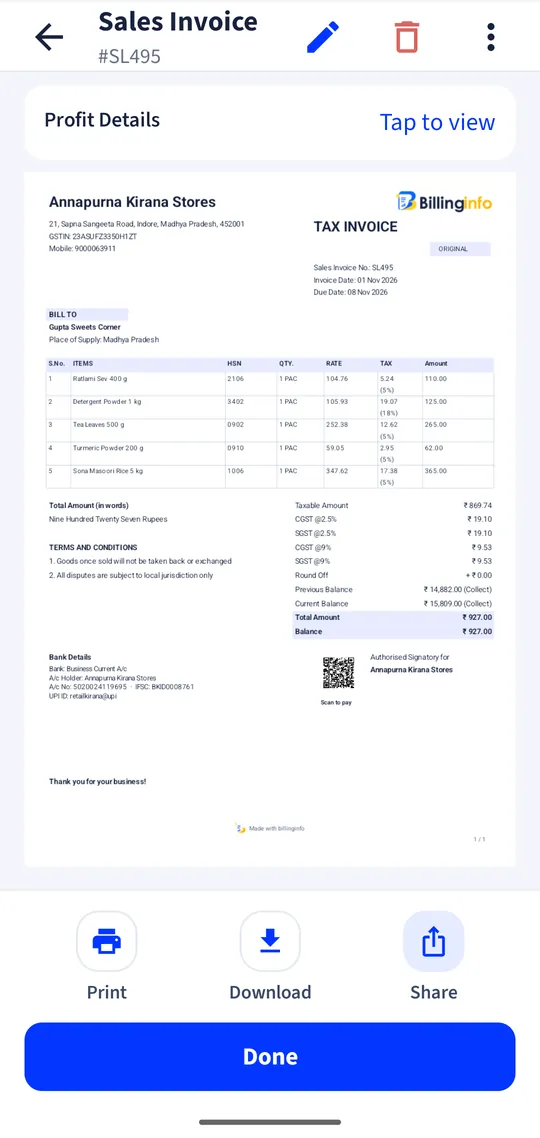
The GSTR-3B report in billinginfo works out Table 3.1 from your sales, returns and reverse charge purchases, and Table 4 from your purchases and expenses with their credit type. Compare it with GSTR-2B on the portal, then file. billinginfo prepares the numbers; it does not file the return.