Last checked 2 November 2026
Which document to issue
| Situation | Document | Rule |
|---|---|---|
| Registered seller, taxable sale | Tax invoice | Section 31, Rule 46 |
| Exempt goods, or a composition taxpayer | Bill of supply | Rule 49 |
| Taxable and exempt items to an unregistered buyer on one bill | Invoice-cum-bill of supply | Rule 46A |
| Advance received | Receipt voucher | Rule 50 |
| Purchase from an unregistered supplier under reverse charge | Self-invoice and payment voucher | Rules 47A and 52 |
| Goods moving without a sale (job work, approval, branch transfer) | Delivery challan | Rule 55 |
| Price lowered or goods returned after the invoice | Credit note | Section 34, Rule 53 |
Each has its own format page: tax invoice, bill of supply, delivery challan, credit note.
The fields Rule 46 requires
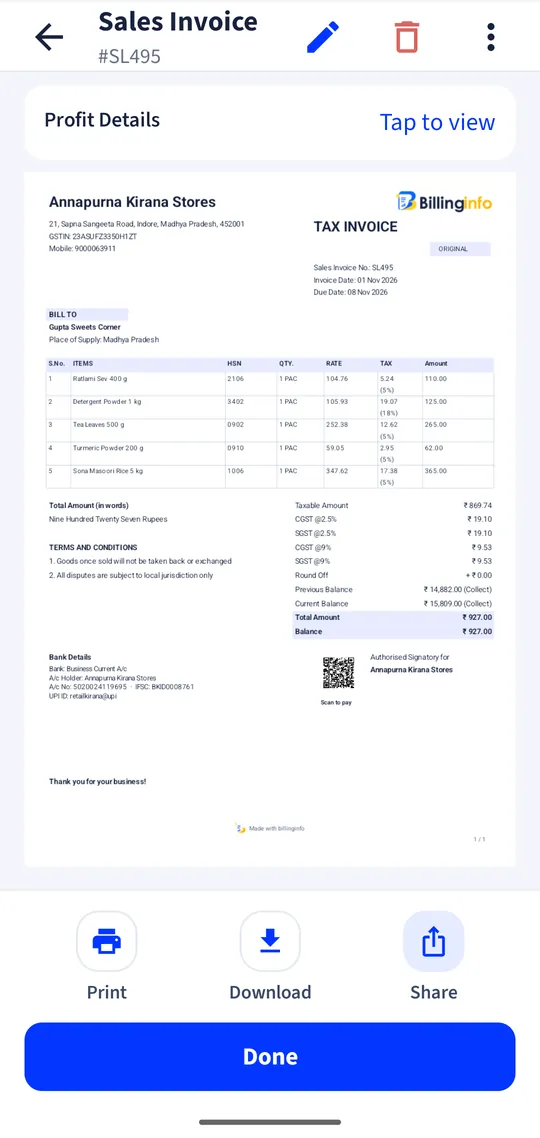
- Supplier’s name, address and GSTIN.
- A consecutive serial number of up to 16 characters, unique for the financial year. Letters, digits, hyphen (-) and slash (/) are allowed.
- Date of issue.
- Recipient’s name, address and GSTIN if registered.
- For an unregistered recipient, when the value is ₹50,000 or more: name, address, delivery address, and State name and code.
- HSN code for goods or SAC for services (see below).
- Description of goods or services.
- Quantity and unit for goods.
- Total value, and the taxable value after discounts or abatement.
- Rate and amount of tax: CGST, SGST/UTGST, IGST and cess shown separately.
- Place of supply with the State name, for inter-State supplies.
- Delivery address if it differs from the place of supply.
- Whether tax is payable on reverse charge.
- Signature or digital signature of the supplier or authorised person (not needed on an electronic invoice issued under the e-invoicing rules).
Businesses covered by e-invoicing must also print the QR code with the IRN. Businesses with aggregate turnover above ₹500 crore must put a dynamic QR code on B2C invoices.
How many HSN digits
| Aggregate turnover in the previous year | HSN/SAC digits on invoices |
|---|---|
| Up to ₹5 crore | 4 digits on B2B tax invoices; optional on B2C |
| Above ₹5 crore | 6 digits on all tax invoices |
This comes from Notification 78/2020-Central Tax, in force from 1 April 2021. More digits are always allowed. Look up codes in our HSN code finder or read the HSN and SAC guide.
When to issue it
- Goods: before or at the time of removal for supply, or delivery if there is no removal (section 31(1)).
- Services: within 30 days of supplying the service (Rule 47). Banks and financial institutions get 45 days.
- Continuous supply: on or before the date each payment is due under the contract.
- Small B2C sales: for a value under ₹200 to an unregistered buyer who does not ask for a bill, one consolidated invoice for the day is allowed.
Copies
Rule 48 says how many copies to make. For goods: the original for the recipient, the duplicate for the transporter and the triplicate for the supplier. For services: the original for the recipient and the duplicate for the supplier. Printing “Original for recipient” on the top copy avoids confusion. Under e-invoicing the IRP-registered electronic invoice is the record, and the transporter copy rule does not apply.
A worked example
Shree Traders in Nashik (State code 27) sells 10 cartons of tea (HSN 0902, 5%) at ₹1,800 each to a registered grocer in Surat (State code 24), with a 2% trade discount.
| Line | Amount |
|---|---|
| 10 × ₹1,800 | ₹18,000.00 |
| Less 2% discount | − ₹360.00 |
| Taxable value | ₹17,640.00 |
| IGST 5% (Gujarat is another State) | ₹882.00 |
| Invoice total | ₹18,522.00 |
Place of supply: 24-Gujarat. Reverse charge: No. Because buyer and seller are in different States, only IGST appears. Check sums like this with the GST calculator.
Mistakes that cost your buyer credit
- Wrong buyer GSTIN: the invoice lands in someone else’s GSTR-2B. Fix it by amending the invoice in GSTR-1.
- Missing place of supply on inter-State bills.
- Two invoice series that repeat numbers in the same year. Use a prefix per series, like A/25-26/001.
- Writing “GST included” without splitting the tax. The rate and amount must be shown.
- Changing the invoice after sharing it. Use a credit or debit note instead (how).
How billinginfo helps
Every invoice made in billinginfo carries the Rule 46 fields: your GSTIN, the party’s GSTIN and State, HSN or SAC per line, CGST and SGST or IGST from the place of supply, reverse-charge marking and your signature. Numbers run in sequence with the prefix you choose for each bill type. Try the free invoice generator or see the GST billing software.