Last checked 2 November 2026
Which one, when
| Situation | Document | Effect |
|---|---|---|
| Customer returns goods | Credit note | Your output tax goes down; the buyer reverses credit |
| You charged too high a price or rate | Credit note | Same |
| Service found deficient, price reduced | Credit note | Same |
| You undercharged the price or the tax | Debit note | Your output tax goes up; the buyer can claim more credit |
| Extra freight or charges billed later | Debit note (or a fresh invoice) | Same |
Section 34 of the CGST Act covers both. A credit note can relate to one or more invoices of the same buyer. A buyer who returns goods to you may send a document they call a debit note; in GST terms it is only the supplier’s credit note that changes the tax.
What a credit or debit note must show (Rule 53)
- The words “Credit Note” or “Debit Note”.
- Name, address and GSTIN of the supplier.
- A consecutive serial number of up to 16 characters, unique for the financial year, and the date of issue.
- Name, address and GSTIN of the recipient if registered; for unregistered buyers, name and address, delivery address, and State name and code.
- Serial number and date of the original invoice (or invoices).
- Value, taxable value, rate of tax and the amount of tax credited or debited.
- Signature or digital signature of the supplier.
See the ready layouts: credit note format and debit note format.
A worked example
A Surat textile wholesaler billed a Mumbai shop for 10 sarees at ₹5,000 each plus IGST 5% (total ₹52,500). The shop returns 2 sarees.
| Credit note line | Amount |
|---|---|
| 2 sarees × ₹5,000 | ₹10,000.00 |
| IGST 5% | ₹500.00 |
| Credit note total | ₹10,500.00 |
| Reference | Invoice SR/26-27/0148 dated 12-10-2026 |
The wholesaler reports the credit note in GSTR-1 for the month it is issued, reducing output IGST by ₹500. The shop sees it in GSTR-2B and reverses ₹500 of credit.
Time limits
- Credit notes: must be declared in a return no later than 30 November after the end of the financial year in which the original supply was made, or the date of filing the annual return, whichever is earlier (section 34(2)). A credit note for a March 2026 sale must be reported by 30 November 2026.
- The supplier can reduce its tax only if the buyer has reversed the credit, or the tax was not passed on to the buyer.
- Debit notes: no time limit to issue. The buyer’s credit on a debit note follows the section 16(4) limit for the year in which the debit note is issued.
- Businesses under e-invoicing must report credit and debit notes on the IRP too; those with turnover of ₹10 crore or more have 30 days from the document date.
Discounts after the sale
A discount given after the sale (a year-end target discount, say) reduces the taxable value only if it was agreed before or at the time of the supply and can be linked to the invoices, and the buyer reverses the matching credit (section 15(3)(b)). Otherwise the supplier can issue a financial or commercial credit note without GST: it settles the account but does not change the tax. Ask your CA which applies to your scheme before booking it.
In your returns
- GSTR-1: registered buyers under CDNR, unregistered under CDNUR (for inter-State B2C above the limit) or adjusted in B2CS.
- GSTR-3B: the net effect reduces or adds to output tax in Table 3.1 for the month.
- The buyer sees your credit note in GSTR-2B and must reverse credit in Table 4(B).
Common mistakes
- Editing the original invoice after it was reported, instead of issuing a note.
- Leaving out the original invoice number, so the buyer cannot match it.
- Issuing a GST credit note for a discount that was never agreed in advance.
- Missing the 30 November cut-off for last year’s sales returns.
How billinginfo helps
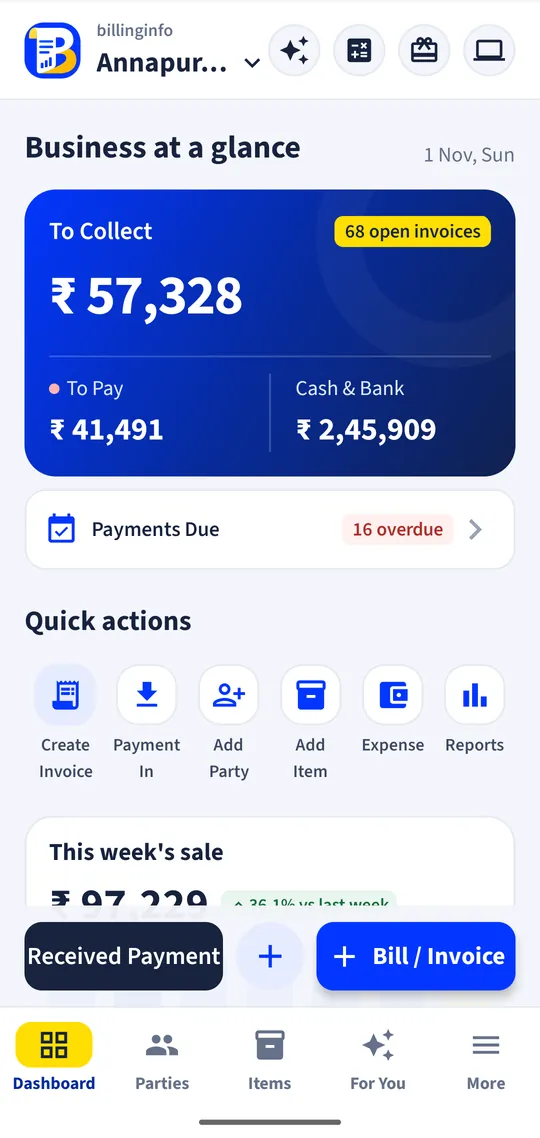
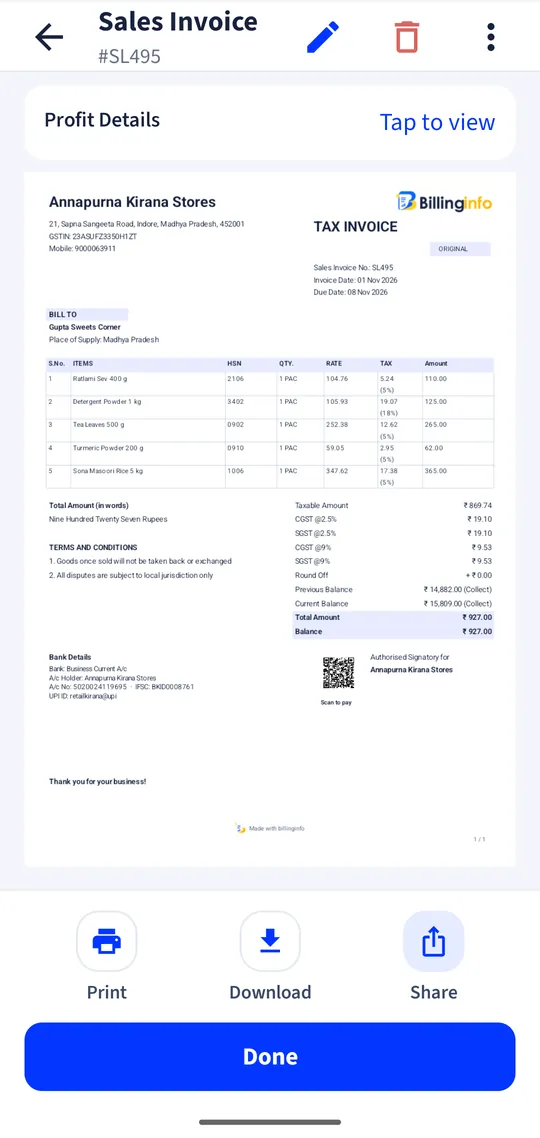
In billinginfo, a sales return creates a credit note linked to the original invoice, puts the goods back into stock and lowers the party’s balance. A purchase return creates a debit note and reduces stock. Both appear in the GSTR-1 and GSTR-3B reports in the right tables.