Last checked 2 November 2026
GST in one paragraph
GST is a tax on the supply of goods and services. Every business in the chain charges GST on what it sells and gets back the GST it paid on what it bought. Only the value added at each step is taxed, and the full tax is finally paid by the person who consumes the goods or service. GST replaced VAT, excise duty, service tax, entry tax and several other taxes from 1 July 2017.
For a small business, GST means three things: charge the right rate on your bills, keep the GST you paid on purchases so you can claim it back, and file returns that tell the government both numbers.
CGST, SGST, IGST and UTGST
India has one GST law for the Centre and one for each State, so a single sale can carry two taxes:
| Tax | Who gets it | When it applies |
|---|---|---|
| CGST + SGST | Centre and the State, half each | Seller and place of supply in the same State (intra-state) |
| CGST + UTGST | Centre and the Union Territory | Intra-state supply in a UT without a legislature, like Chandigarh or Ladakh |
| IGST | Centre, which settles the State share | Seller and place of supply in different States, imports and exports |
Example: a Pune shop sells a pressure cooker for ₹2,000 plus 18% GST to a customer in Pune. The bill shows CGST 9% ₹180 and SGST 9% ₹180. If the same cooker is sent to a buyer in Indore, the bill shows IGST 18% ₹360 instead. The customer pays ₹2,360 either way. The place of supply guide explains how to decide which one applies.
How input tax credit keeps tax from piling up
Input tax credit (ITC) is the GST you paid on business purchases. You subtract it from the GST you collected on sales and pay only the difference.
| Step | Sale value | GST at 18% | ITC claimed | GST paid in cash |
|---|---|---|---|---|
| Manufacturer sells to wholesaler | ₹1,000 | ₹180 | ₹0 | ₹180 |
| Wholesaler sells to retailer | ₹1,200 | ₹216 | ₹180 | ₹36 |
| Retailer sells to customer | ₹1,500 | ₹270 | ₹216 | ₹54 |
The government collects ₹270 in total, which is exactly 18% of the final price. Each business paid tax only on the value it added. Credit comes with conditions: you need a proper tax invoice, the supplier must report it, and you must pay the supplier within 180 days. See input tax credit basics.
The rate slabs after GST 2.0
From 22 September 2025 the GST Council simplified the rates. Most goods now fall into two main slabs, 5% and 18%, with a 40% rate for a short list of luxury and sin goods. Gold and jewellery stay at 3%, rough diamonds and precious stones at 0.25%, cut diamonds at 1.5%, and many essentials are exempt (0%). A few items still carry 12% or 28% under separate entries. The goods rates are in Notification 9/2025-Central Tax (Rate).
Always check the rate for your exact HSN code rather than a general list. Our HSN code finder shows the official description and a suggested rate, and the GST rates guide has examples.
Who has to register
You must register once your aggregate turnover crosses the threshold for your State: ₹40 lakh for businesses that only sell goods in most States, ₹20 lakh for services (lower limits apply in some north-eastern and hill States). Some businesses must register from the first sale whatever their turnover, for example anyone making inter-State sales of goods or selling goods through an e-commerce operator that collects tax (with some relief for small sellers). Small businesses can also choose the composition scheme, which has a flat low rate and simpler returns. Details are in GST registration basics.
What you file and when
A regular taxpayer files two main returns:
- GSTR-1: the details of your sales invoices, credit notes and debit notes. Monthly by the 11th, or quarterly by the 13th under the QRMP scheme. See GSTR-1 explained.
- GSTR-3B: the summary return where you pay the tax. Monthly by the 20th, or quarterly by the 22nd or 24th depending on your State. See GSTR-3B explained.
- GSTR-9: the annual return, due 31 December after the year ends. It is optional for businesses with turnover up to ₹2 crore.
Late returns cost a late fee and 18% a year interest on tax paid late. Since the July 2025 tax period, the GST portal also blocks filing a return more than three years after its due date, so old returns cannot be filed at all.
Common mistakes small businesses make
- Charging CGST + SGST on a sale to another State. The tax goes to the wrong account and must be paid again under the right head before the wrong one is refunded.
- Using an old rate after a rate change. GST 2.0 moved hundreds of items; recheck every item in your list.
- Claiming credit on bills your supplier never reported. Credit only flows from invoices that show up in your GSTR-2B.
- Missing the HSN code on B2B invoices. Businesses with turnover up to ₹5 crore must show at least 4 digits; above that, 6 digits.
- Not keeping a copy of every bill. Records must be kept for 72 months from the due date of the annual return.
How billinginfo helps
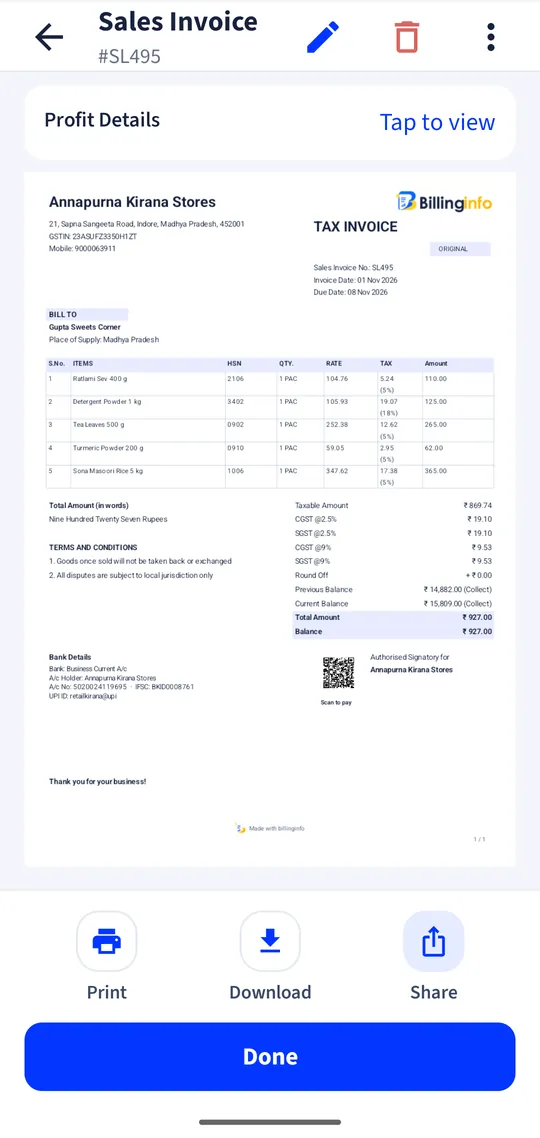
billinginfo works out CGST and SGST or IGST from the party’s State, keeps the HSN code and GST rate on each item, and builds GSTR-1, GSTR-2 and GSTR-3B reports from your bills so you or your accountant can file on the GST portal. It does not file returns for you. Start with the GST billing software page or try the free GST calculator.