Last checked 2 November 2026
When a delivery challan is used
Rule 55 of the CGST Rules allows a challan in place of an invoice for:
- Job work: sending material to a job worker and getting it back.
- Transport other than by way of supply: goods sent for repair, for exhibition, to your own godown in the same State, or returnable packing.
- Liquid gas where the exact quantity is not known when it leaves.
- Goods sent on approval (sale or return): the invoice follows when the buyer accepts, or within six months.
- Goods in parts or batches (completely or semi-knocked-down) under one invoice.
A transfer to your own branch in another State is a supply between distinct persons, so it needs a tax invoice, not a challan.
What the challan must show
- Date and a serial number of up to 16 characters, unique for the financial year.
- Name, address and GSTIN of the consignor (if registered).
- Name, address and GSTIN or UIN of the consignee (if registered).
- HSN code and description of goods.
- Quantity (provisional, where the exact quantity is not known).
- Taxable value.
- Tax rate and tax amount, CGST, SGST, IGST and cess, where the goods move for supply to the consignee.
- Place of supply, for inter-State movement.
- Signature.
Copies: original for the consignee, duplicate for the transporter, triplicate for the consignor. See the delivery challan format.
Challans and e-way bills
A challan is a valid document for an e-way bill. If the consignment value is over ₹50,000 (or your State’s limit within the State), generate an e-way bill and mention its number. Two cases need an e-way bill whatever the value: inter-State movement of goods to or from a job worker, and inter-State movement of handicraft goods by a person exempt from registration. See e-way bill rules.
Goods sent in batches
For goods sent in several lots under one sale, like machinery shipped in parts (Rule 55(5)):
- Issue the complete tax invoice before the first lot leaves.
- Send each lot with a delivery challan that refers to the invoice.
- Send the original invoice with the last lot.
Job work time limits
Section 143 lets you send inputs and capital goods to a job worker without paying tax, if they come back in time:
| Goods sent | Must come back within | If not |
|---|---|---|
| Inputs | 1 year | Treated as supplied on the day they were sent; pay tax with interest |
| Capital goods (except moulds, dies, jigs, fixtures and tools) | 3 years | Same |
| Moulds, dies, jigs, fixtures, tools | No limit | – |
Report movements to and from job workers in Form ITC-04: half-yearly if your turnover is above ₹5 crore, yearly otherwise.
A worked example
A Rajkot pump maker sends 200 castings worth ₹1,60,000 to a machining job worker in the same city.
- Document: delivery challan DC/26-27/031, purpose “job work”, HSN 7325, quantity 200 NOS, value ₹1,60,000.
- No tax charged: the castings remain the pump maker’s.
- Value above ₹50,000, so an e-way bill is generated against the challan (assuming the State applies the ₹50,000 limit to movement within the State).
- The job worker returns the machined castings with its own challan and a tax invoice for its job charges at the job-work rate that applies.
Common mistakes
- Selling on a challan and never raising the invoice. A challan does not replace an invoice for a sale.
- Using a challan for a transfer to a branch in another State.
- Leaving out the value: the challan needs a taxable value even when no tax is charged.
- Losing track of job-work goods past one year.
Challan or invoice? A quick test
| Movement | Document |
|---|---|
| Sale within your State, goods go with the bill | Tax invoice |
| Goods sent to a customer to try before buying | Delivery challan, then invoice on acceptance |
| Material sent to a job worker | Delivery challan (and e-way bill if needed) |
| Stock moved to your own godown in the same State | Delivery challan |
| Stock moved to your own branch in another State | Tax invoice with IGST |
| Returnable crates or cylinders | Delivery challan |
| Goods sent for repair and coming back | Delivery challan |
How billinginfo helps
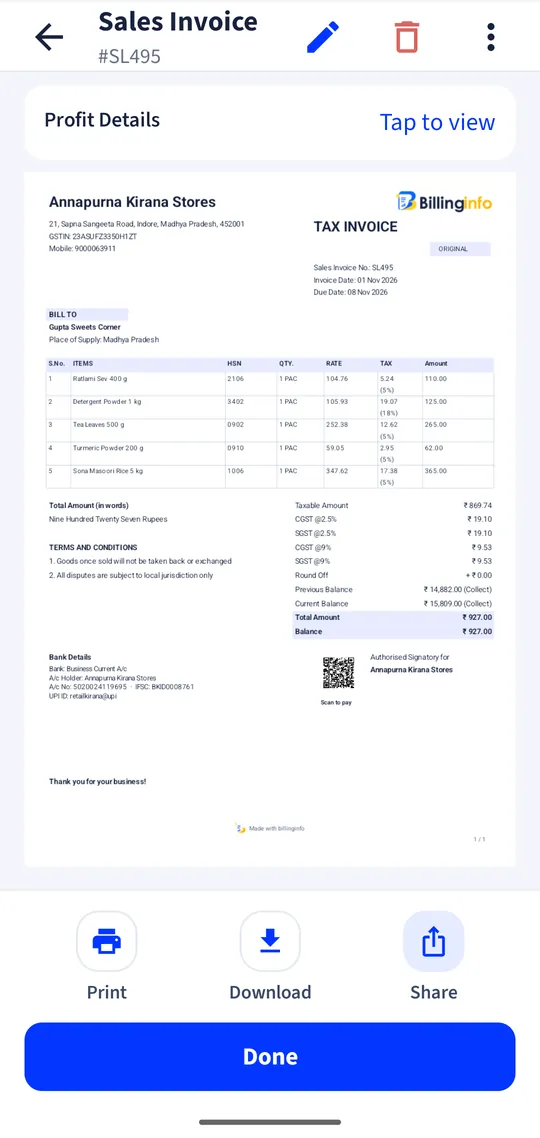
billinginfo makes delivery challans with their own numbering, prints them on A4 or A5, and converts a challan into a sales invoice in one tap when the sale happens. On paid plans you can generate an e-way bill straight from the challan.